



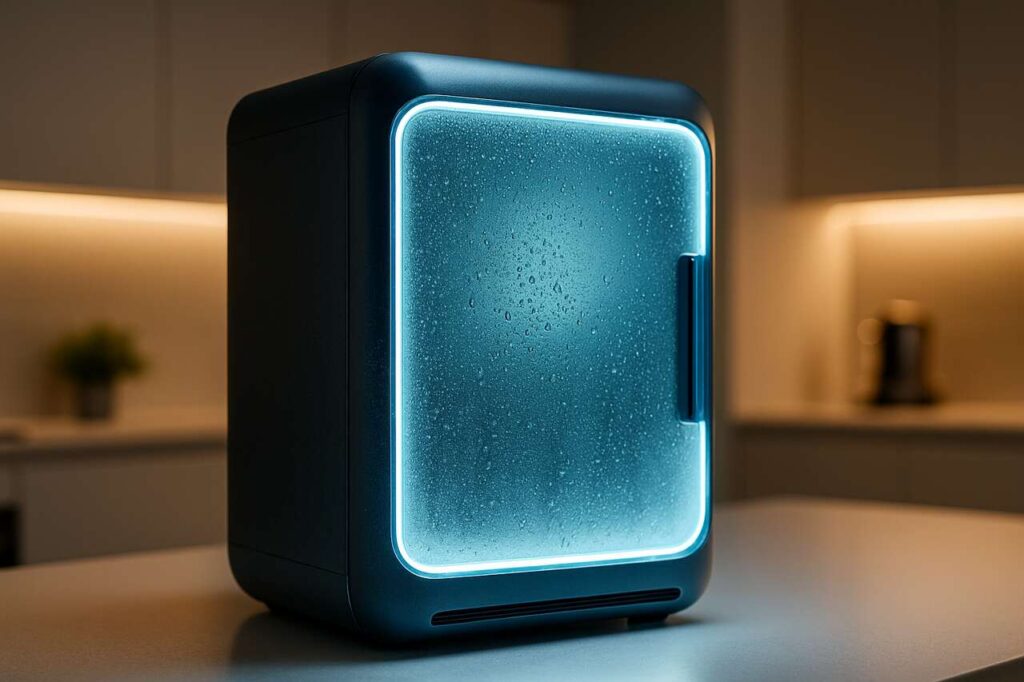
Refrigeration technology has remained largely unchanged for decades, relying on vapour-compression systems that consume vast amounts of energy and utilise harmful refrigerants. However, researchers have now developed a groundbreaking alternative that promises to revolutionise how we keep things cold. This innovative approach harnesses the unique properties of certain materials to achieve cooling without the traditional compressor-driven cycle, potentially transforming everything from household appliances to industrial cold storage facilities.
Introduction to the new refrigeration system
The elastocaloric cooling mechanism
The newly invented refrigeration method relies on elastocaloric materials, which exhibit remarkable temperature changes when mechanically stressed and released. Unlike conventional systems that compress and expand gases, this technique applies physical force to specially engineered materials, causing them to heat up when stretched or compressed and cool down when the stress is removed. Scientists have identified several promising materials for this purpose:
- Shape-memory alloys such as nickel-titanium compounds
- Specially designed polymers with enhanced elastocaloric properties
- Composite materials that combine multiple elastocaloric substances
- Natural rubber variants with optimised molecular structures
How the system operates in practice
The operational cycle begins when a mechanical device applies tension or compression to the elastocaloric material, generating heat that is then dissipated into the surrounding environment. Once the material reaches ambient temperature whilst still under stress, the force is released, causing the material to cool below its starting temperature. This cold state can then absorb heat from the compartment requiring refrigeration. The process repeats continuously, creating a sustained cooling effect without the need for traditional refrigerants or compressors.
This fundamental shift in approach addresses many limitations inherent in conventional refrigeration whilst opening new possibilities for efficient thermal management across various sectors.
The scientific principles at play
Thermodynamic foundations
The elastocaloric effect operates according to well-established thermodynamic principles, particularly those governing entropy changes in materials under mechanical stress. When force is applied to an elastocaloric material, its molecular structure becomes more ordered, reducing entropy and releasing heat. The reverse process occurs when the stress is removed, with the material’s molecular arrangement becoming less ordered, increasing entropy and absorbing heat from its surroundings.
| Process stage | Mechanical action | Temperature change | Heat transfer |
|---|---|---|---|
| Loading phase | Stress applied | Increases by 5-20°C | Heat released to environment |
| Unloading phase | Stress removed | Decreases by 5-20°C | Heat absorbed from cold space |
Material science innovations
The effectiveness of elastocaloric cooling depends heavily on the specific materials employed. Researchers have focused on substances that demonstrate large temperature changes with relatively small mechanical inputs, ensuring energy efficiency. Advanced nickel-titanium alloys have emerged as particularly promising candidates, offering temperature variations exceeding fifteen degrees Celsius with moderate stress application. These materials also exhibit excellent durability, withstanding millions of stress cycles without significant degradation.
Understanding these scientific foundations provides essential context for appreciating the practical advantages this technology offers.
Economic and environmental benefits
Energy efficiency gains
Elastocaloric refrigeration systems demonstrate superior energy efficiency compared to conventional vapour-compression technology. Early prototypes have achieved coefficient of performance values approaching ten, meaning they move ten units of heat for every unit of energy consumed. This represents a substantial improvement over traditional systems, which typically achieve coefficients between two and four. The enhanced efficiency translates directly into:
- Reduced electricity consumption for residential and commercial cooling
- Lower operational costs for cold storage facilities
- Decreased strain on electrical grids during peak cooling seasons
- Significant long-term savings for consumers and businesses
Environmental advantages
Perhaps the most compelling benefit lies in the elimination of harmful refrigerants. Conventional systems rely on hydrofluorocarbons and other chemicals that contribute significantly to global warming when released into the atmosphere. Elastocaloric technology uses only solid materials and mechanical action, completely avoiding these problematic substances. This advancement addresses growing regulatory pressure to phase out high-global-warming-potential refrigerants whilst simultaneously reducing the carbon footprint associated with cooling operations.
These economic and environmental advantages position elastocaloric refrigeration as an increasingly attractive alternative for various applications.
Practical applications and innovations
Domestic refrigeration solutions
Engineers are developing compact elastocaloric units suitable for household refrigerators and freezers. These devices incorporate thin films of elastocaloric material arranged in cascading configurations to achieve the temperature differentials required for food preservation. The systems operate more quietly than conventional compressor-based appliances, as they lack the vibrating mechanical components that generate noise. Manufacturers anticipate that early commercial models will appear within the next few years, initially targeting premium market segments before broader adoption.
Industrial and commercial implementations
Large-scale applications present particularly exciting opportunities for this technology. Cold storage warehouses, supermarket refrigeration systems, and industrial process cooling can all benefit from the enhanced efficiency and environmental credentials of elastocaloric systems. Several pilot projects are currently underway to demonstrate viability in these demanding contexts:
- Temperature-controlled logistics facilities for pharmaceutical distribution
- Food processing plants requiring precise thermal management
- Data centres seeking sustainable cooling solutions
- Marine refrigeration systems for fishing vessels
These diverse applications demonstrate the technology’s versatility and readiness for real-world deployment.
Potential impact on the global market
Market disruption forecasts
Industry analysts project that elastocaloric refrigeration could capture a significant share of the global cooling market within two decades. The worldwide refrigeration and air conditioning sector currently represents hundreds of billions in annual revenue, with steady growth driven by rising temperatures and expanding middle-class populations in developing nations. Even modest penetration by this new technology would represent substantial market displacement and economic transformation.
Competitive landscape considerations
Established manufacturers face strategic decisions regarding investment in elastocaloric technology versus continued optimisation of conventional systems. Some major appliance producers have already formed partnerships with research institutions to secure early access to intellectual property and manufacturing expertise. Meanwhile, start-up companies specialising exclusively in elastocaloric solutions are attracting venture capital funding, creating a dynamic competitive environment that should accelerate development and commercialisation.
This evolving market landscape sets the stage for examining what the future holds for this transformative technology.
Future prospects for the technology
Research directions and improvements
Scientists continue refining elastocaloric materials to enhance their performance characteristics. Current research priorities include developing materials that function effectively across wider temperature ranges, improving mechanical durability for extended operational lifespans, and reducing manufacturing costs to enable mass production. Nanotechnology approaches show particular promise, with engineered materials at the molecular level potentially offering unprecedented elastocaloric effects.
Integration with renewable energy
The mechanical nature of elastocaloric cooling creates opportunities for direct integration with renewable energy sources. Wind turbines and hydroelectric systems could potentially drive refrigeration units without electrical conversion, improving overall system efficiency. This synergy between sustainable cooling and renewable power generation represents an important pathway towards decarbonising the cold chain industry.
Refrigeration technology stands at a pivotal moment, with elastocaloric systems offering compelling advantages over conventional approaches. The combination of superior energy efficiency, elimination of harmful refrigerants, and broad applicability across residential, commercial, and industrial sectors positions this innovation as a genuine breakthrough. Whilst challenges remain in scaling production and reducing costs, the scientific foundations are sound and the economic incentives substantial. As materials science advances and manufacturing techniques mature, elastocaloric refrigeration appears poised to become a cornerstone of sustainable cooling infrastructure, fundamentally changing how humanity manages thermal energy in an increasingly warm world.