



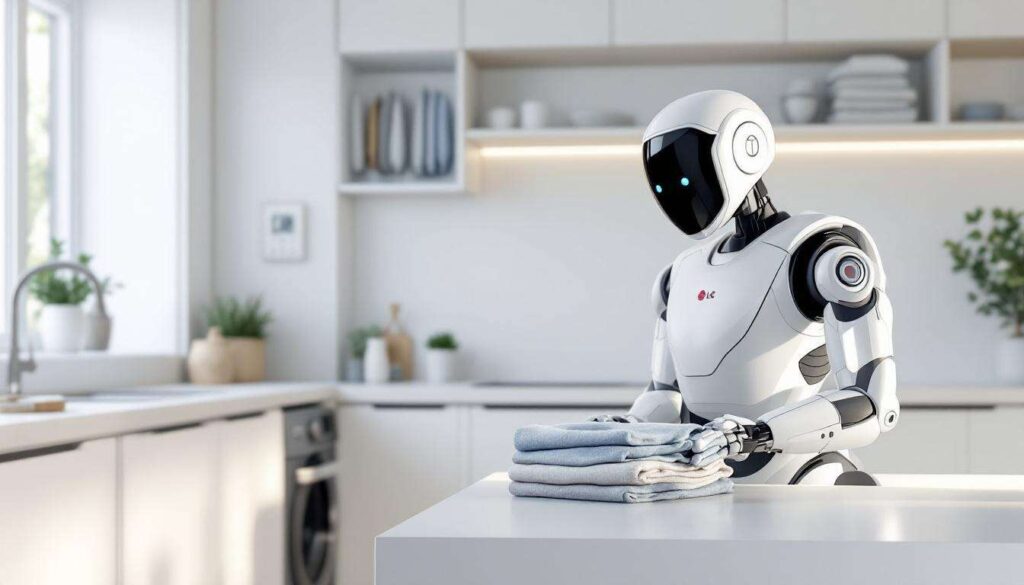
Household chores have long been considered a necessary burden, consuming precious hours that could be spent on more fulfilling activities. The tedious task of folding laundry, in particular, has remained largely unchanged despite technological advances in other areas of domestic life. However, LG Electronics has unveiled a groundbreaking solution that promises to transform this mundane routine into an automated process. The South Korean technology giant’s latest innovation represents a significant leap forward in domestic robotics, offering consumers a glimpse into a future where machines handle repetitive household tasks with precision and efficiency.
The era of domestic robots: a revolution underway
From science fiction to reality
The concept of household robots has transitioned from the realm of futuristic fantasies to tangible products available on the market. What once appeared in films and novels as distant possibilities has become increasingly accessible to everyday consumers. Modern domestic robots now perform various functions, from vacuuming floors to monitoring home security, demonstrating that automation has firmly established itself within residential environments.
Current applications in the home
Today’s market offers a diverse range of robotic assistants designed to simplify domestic responsibilities. These devices have evolved considerably in both capability and affordability, making them attractive options for busy households. The most common applications include:
- Autonomous vacuum cleaners that navigate rooms independently
- Robotic lawn mowers maintaining gardens without human intervention
- Window-cleaning robots tackling high-rise surfaces safely
- Smart kitchen appliances that prepare meals with minimal supervision
- Pool-cleaning robots ensuring hygienic swimming environments
These innovations have paved the way for more sophisticated machines, such as LG’s laundry-folding robot, which addresses one of the most time-consuming household tasks. The progression from simple automated devices to complex robotic systems reflects a broader transformation in how technology integrates with daily routines.
LG: a pioneer in robotic technology
A history of innovation
LG Electronics has consistently positioned itself at the forefront of consumer technology development, investing substantial resources into research and development. The company’s commitment to innovation extends across multiple product categories, from televisions and smartphones to home appliances. This dedication has earned LG a reputation as a forward-thinking manufacturer willing to explore unconventional solutions to everyday problems.
Previous robotic ventures
Before introducing the laundry-folding robot, LG had already demonstrated its capabilities in robotics through several notable products. The company developed autonomous vacuum cleaners, commercial service robots for airports and hotels, and even companion robots designed to assist elderly individuals. These earlier projects provided valuable experience in artificial intelligence, machine learning, and mechanical engineering that would prove essential for more ambitious undertakings.
| Product Category | Launch Period | Primary Function |
|---|---|---|
| CLOi ServeBot | 2020 | Commercial delivery and service |
| CLOi GuideBot | 2019 | Information and navigation assistance |
| CordZero Robotic Vacuum | 2018 | Autonomous floor cleaning |
This track record demonstrates that LG’s laundry-folding robot represents not an isolated experiment but rather the culmination of years of expertise in robotics and automation.
How does LG’s folding robot work ?
Technical specifications and design
LG’s laundry-folding robot employs advanced computer vision and artificial intelligence to identify different garment types and determine the optimal folding method for each item. The machine features robotic arms equipped with sensitive grippers capable of handling delicate fabrics without causing damage. Its sophisticated sensors detect fabric texture, size, and shape, allowing the robot to adjust its approach accordingly.
The folding process explained
The operation begins when users place clean, dry laundry into the robot’s input compartment. The system then performs several sequential steps:
- Scanning each garment using integrated cameras and sensors
- Identifying the item type (shirt, trousers, towel, etc.)
- Selecting the appropriate folding pattern from its database
- Executing precise movements to fold the garment neatly
- Stacking completed items in an organized output section
The entire process occurs without human intervention, with the robot capable of handling mixed loads containing various clothing types. Machine learning algorithms enable the device to improve its performance over time, adapting to the specific garments frequently used by the household.
Integration with smart home systems
Beyond its standalone capabilities, LG’s robot connects to smart home ecosystems, allowing users to monitor progress remotely via smartphone applications. This connectivity enables scheduling functions, maintenance alerts, and performance statistics, providing comprehensive control over the laundry-folding process. Such integration represents a broader trend towards interconnected domestic appliances that communicate seamlessly with one another.
The benefits of a domestic robot in daily life
Time savings and efficiency
The most immediate advantage of a laundry-folding robot lies in the substantial time savings it offers. Research indicates that the average household spends several hours weekly on laundry-related tasks, with folding representing a significant portion of this time. By automating this process, families reclaim valuable hours that can be redirected towards professional pursuits, leisure activities, or quality time with loved ones.
Consistency and quality
Unlike human folding, which may vary in quality depending on fatigue or distraction, robotic systems deliver consistent results with every cycle. Garments emerge uniformly folded, making wardrobe organization more efficient and visually appealing. This consistency also reduces wrinkles, potentially decreasing the need for ironing and further streamlining household routines.
Accessibility for diverse users
Laundry-folding robots provide particular benefits for individuals with physical limitations or mobility challenges. Those experiencing arthritis, back problems, or other conditions that make repetitive bending and folding difficult find these devices especially valuable. The technology promotes independent living by enabling people to maintain their households without requiring assistance for routine tasks.
| User Group | Primary Benefit | Impact Level |
|---|---|---|
| Working professionals | Time reclamation | High |
| Elderly individuals | Physical ease | Very high |
| Large families | Volume management | High |
| People with disabilities | Independence | Very high |
These advantages collectively demonstrate how domestic robots extend beyond mere convenience, offering genuine improvements in quality of life across diverse demographics.
Impact on our lifestyle and the future of housekeeping
Shifting household dynamics
The introduction of laundry-folding robots and similar devices fundamentally alters how families approach domestic responsibilities. Traditional divisions of household labour may evolve as automation eliminates certain tasks entirely, potentially reducing sources of domestic conflict and creating more equitable arrangements. This shift allows households to focus human effort on activities that require creativity, emotional intelligence, or complex decision-making.
Economic considerations
Whilst the initial investment in robotic technology represents a significant expense, long-term economic analysis reveals potential savings. Reduced wear on clothing from consistent folding techniques, decreased energy consumption from optimized laundry routines, and the value of reclaimed time all contribute to the overall cost-benefit equation. As production scales increase and technology matures, prices are expected to decline, making these devices accessible to broader market segments.
Environmental implications
Domestic robots may contribute to sustainability efforts through improved efficiency. Precise folding reduces wrinkles, potentially decreasing reliance on energy-intensive ironing. Additionally, integrated smart systems can optimize laundry schedules to coincide with off-peak electricity periods, reducing strain on power grids and lowering carbon footprints. However, the environmental impact of manufacturing and disposing of electronic devices must also be considered in comprehensive assessments.
Robotics and artificial intelligence: towards new innovations
Emerging technologies in domestic automation
The success of laundry-folding robots points towards a future filled with increasingly sophisticated domestic assistants. Researchers are developing machines capable of performing complex tasks such as preparing complete meals, organizing wardrobes, and even providing companionship. Advances in artificial intelligence enable these devices to learn user preferences, anticipate needs, and adapt to changing circumstances without explicit programming.
Challenges and limitations
Despite remarkable progress, domestic robotics faces several obstacles that must be addressed before widespread adoption occurs. Technical challenges include:
- Handling delicate or irregularly shaped items safely
- Operating reliably in diverse home environments
- Maintaining affordability whilst incorporating advanced features
- Ensuring data privacy and cybersecurity in connected devices
- Developing intuitive interfaces accessible to all age groups
Overcoming these hurdles requires continued investment in research, collaboration between technology companies and consumers, and thoughtful regulatory frameworks that protect users whilst encouraging innovation.
The human element in an automated future
As robots assume more household responsibilities, questions arise about the role of human involvement in domestic life. Rather than replacing human activity entirely, successful automation should complement and enhance it, freeing people to engage in more meaningful pursuits. The goal is not to eliminate all manual tasks but to provide choices, allowing individuals to decide how they allocate their time and energy.
LG’s laundry-folding robot exemplifies how technology can address genuine needs whilst raising important questions about the future relationship between humans and machines. As domestic robotics continues evolving, the focus must remain on creating tools that genuinely improve lives rather than simply showcasing technical capabilities. The revolution in household automation has begun, promising a future where tedious chores become optional rather than obligatory, and where technology serves as a genuine partner in maintaining comfortable, efficient homes.