



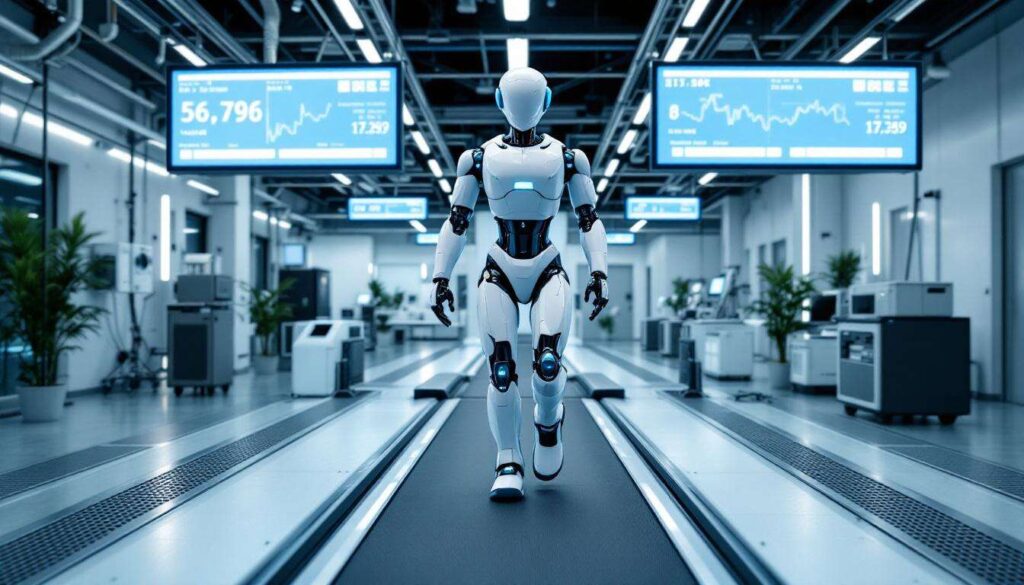
A groundbreaking achievement in robotics has captured global attention as a Chinese humanoid robot successfully completed an unprecedented 65-mile continuous trek, earning recognition from Guinness World Records. This remarkable feat demonstrates the rapid advancement of autonomous walking technology and marks a significant milestone in the development of machines capable of sustained, independent locomotion. The robot’s ability to traverse such a considerable distance without human intervention showcases the sophisticated engineering and artificial intelligence systems that power modern humanoid platforms. As nations compete to lead the robotics revolution, this accomplishment positions China at the forefront of innovation in autonomous systems and highlights the practical applications these machines may soon fulfil in various sectors.
Presentation of the humanoid robot record
The Guinness World Record was officially awarded to a humanoid robot developed by Chinese researchers for completing the longest distance walked by a bipedal robot without stopping. The 65-mile journey represents a quantum leap in endurance capabilities for machines designed to replicate human movement patterns. Previous records in this category had been substantially shorter, making this achievement particularly noteworthy within the robotics community.
Record verification process
Guinness World Records officials monitored the entire journey through multiple verification methods to ensure compliance with strict guidelines. The robot was required to maintain continuous forward motion using only its bipedal walking mechanism, without any external assistance or physical support. Independent adjudicators documented every mile of the trek, recording timestamps and environmental conditions throughout the attempt.
| Verification criterion | Requirement |
|---|---|
| Distance | Minimum 65 miles |
| Locomotion method | Bipedal walking only |
| Autonomy | No human intervention |
| Continuity | No stops or pauses |
The successful completion of this challenge under such rigorous conditions demonstrates not only the robot’s physical capabilities but also the reliability of its control systems over extended operational periods. This achievement naturally leads to questions about the specific technological features that enabled such an impressive performance.
The robot’s features and capabilities
The humanoid robot incorporates cutting-edge technology across multiple systems, from its power supply to its balance control mechanisms. Engineers equipped the machine with advanced sensors that continuously monitor terrain conditions, allowing real-time adjustments to gait and posture. The artificial intelligence algorithms governing its movement patterns enable the robot to navigate varying surfaces whilst maintaining stability and energy efficiency.
Power management system
One of the most critical aspects of the robot’s design is its battery technology, which sustained operations throughout the entire 65-mile journey. The power management system optimises energy consumption by adjusting motor output based on terrain difficulty and required walking speed. This intelligent distribution of electrical resources prevents premature depletion whilst maintaining consistent performance levels.
Balance and locomotion technology
The robot’s ability to maintain upright posture over such distances relies on sophisticated gyroscopic sensors and accelerometers that detect even minute shifts in balance. Key features include:
- Dynamic stability control that adjusts centre of gravity in real time
- Adaptive joint mechanisms that respond to uneven terrain
- Predictive algorithms that anticipate balance challenges before they occur
- Redundant systems that ensure continued operation if individual components fail
These technological capabilities were put to the ultimate test during the record-breaking journey, where numerous obstacles and environmental factors challenged the robot’s endurance.
The 65-mile journey: challenges and stakes
The route selected for the record attempt presented diverse terrain conditions that tested every aspect of the robot’s design. From flat surfaces to inclined paths, the machine encountered obstacles that would challenge even well-designed bipedal systems. Weather conditions during the trek added another layer of complexity, with temperature fluctuations potentially affecting battery performance and joint lubrication.
Technical obstacles overcome
Throughout the journey, the robot faced several critical challenges that could have terminated the attempt. The continuous operation without maintenance or adjustment required exceptional reliability from all components. Engineers monitoring the attempt noted several moments when the robot’s adaptive systems prevented potential failures:
- Adjustments to walking patterns when encountering surface irregularities
- Power redistribution during uphill sections to prevent battery depletion
- Balance recovery after unexpected environmental disturbances
- Temperature regulation to maintain optimal operating conditions for electronic components
Strategic importance of the achievement
Beyond the technical accomplishment, this record carries significant strategic implications for China’s robotics sector. Demonstrating such advanced capabilities signals the nation’s commitment to leading in autonomous systems development. The successful completion proves that Chinese research institutions can produce robots capable of real-world applications requiring sustained autonomous operation.
The implications of this technological demonstration extend far beyond the immediate achievement, influencing how the robotics industry perceives future possibilities.
The impact of this record on the robotics industry
This milestone has sent ripples throughout the global robotics community, prompting reassessment of what humanoid platforms can achieve. Manufacturers and researchers worldwide now recognise that extended autonomous operation is no longer a theoretical possibility but a demonstrated reality. The record establishes new benchmarks for endurance and reliability that will influence design specifications for future humanoid robots.
Commercial applications emerging
Industries that previously dismissed humanoid robots as impractical are now reconsidering their potential utility. The proven ability to operate continuously over long distances opens opportunities in:
- Security and surveillance operations requiring extended patrol routes
- Warehouse logistics where robots could replace human workers in repetitive tasks
- Emergency response scenarios demanding sustained operation in hazardous environments
- Agricultural monitoring across large properties
Investment in humanoid robotics research has already increased following this achievement, with venture capital firms showing renewed interest in companies developing similar technologies. This momentum suggests accelerated development timelines for next-generation platforms.
Future prospects for humanoid technology in China
Chinese authorities have identified robotics as a strategic priority within their national development plans. Government funding for research institutions has increased substantially, enabling ambitious projects that push technological boundaries. The successful record attempt validates this investment strategy and encourages further resource allocation to humanoid development programmes.
Integration into society
Plans are already underway to deploy advanced humanoid robots in various public and private sector roles across China. These applications range from customer service positions to industrial manufacturing environments. The demonstrated reliability shown during the record attempt provides confidence that these machines can fulfil assigned duties without constant human supervision.
As China advances its domestic capabilities, the international community watches closely, with both admiration and concern about the competitive landscape this creates.
International reactions and economic implications
Global responses to China’s achievement have been mixed, combining acknowledgement of the technical accomplishment with awareness of the competitive pressures it creates. Nations with established robotics industries recognise the need to accelerate their own development programmes to maintain technological parity. This competitive dynamic is already influencing government funding decisions and research priorities worldwide.
Economic considerations
The commercial potential of reliable humanoid robots represents a substantial economic opportunity. Market analysts project significant growth in the robotics sector, with humanoid platforms expected to capture increasing market share. China’s demonstrated capabilities position its manufacturers advantageously to supply this emerging market.
| Sector | Potential application | Market impact |
|---|---|---|
| Manufacturing | Assembly line workers | High |
| Healthcare | Patient assistance | Medium |
| Logistics | Warehouse operations | High |
| Services | Hospitality roles | Medium |
The record-breaking achievement serves as compelling evidence of Chinese technological sophistication, potentially influencing international procurement decisions and partnership opportunities. Companies seeking reliable humanoid platforms may increasingly look to Chinese manufacturers as preferred suppliers.
The successful 65-mile trek represents more than an isolated technical achievement. It demonstrates that humanoid robots have reached a maturity level where practical deployment becomes feasible across numerous applications. China’s investment in this technology has yielded tangible results that position the nation as a leader in autonomous systems development. The ripple effects of this accomplishment will influence research priorities, commercial strategies, and competitive dynamics within the global robotics industry for years to come. As these machines transition from laboratory curiosities to practical tools, the engineering excellence displayed during this record attempt provides a foundation for the next generation of autonomous humanoid platforms.