



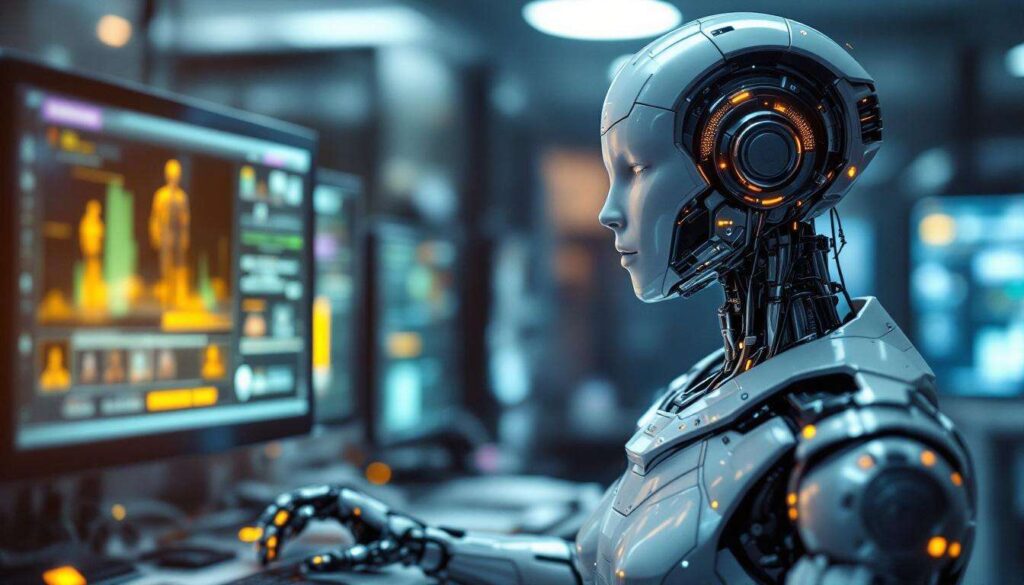
Humanoid robotics has reached a pivotal juncture with the introduction of sophisticated artificial intelligence systems capable of transforming how machines acquire new competencies. The NEO humanoid robot, developed by 1X, now possesses the remarkable ability to teach itself novel skills through video-based learning, eliminating the traditional reliance on extensive programming and human demonstrations. This technological leap represents a fundamental shift in robotics, where machines can observe, interpret and replicate human actions by processing vast quantities of video data. The 1X World Model, the artificial intelligence framework powering this capability, enables NEO to bridge the longstanding gap between digital intelligence and physical execution, opening unprecedented possibilities for autonomous robotic assistance in domestic and professional environments.
The evolution of NEO through video AI
From traditional programming to autonomous observation
The journey towards self-teaching robotics marks a radical departure from conventional methodologies that have dominated the field for decades. Traditional humanoid robots required meticulous programming for each individual task, with engineers dedicating countless hours to coding specific movements and responses. NEO’s video-based learning system fundamentally alters this paradigm by enabling the robot to observe and learn from visual content available across internet platforms.
This evolutionary approach offers several distinct advantages:
- elimination of time-consuming manual programming for routine tasks
- capacity to learn from diverse human demonstrations across multiple contexts
- ability to generalise knowledge from observed actions to novel situations
- continuous improvement through exposure to expanding video datasets
The mechanics of video-based skill acquisition
NEO’s learning process relies on sophisticated visual interpretation algorithms that analyse how humans interact with objects and navigate physical spaces. The robot’s cameras capture environmental details whilst the AI system processes this information against its extensive database of observed human behaviours. This mechanism allows NEO to understand not merely what actions occur, but the contextual reasoning behind them, enabling more intelligent decision-making in real-world scenarios.
Understanding how machines can now learn from observation naturally leads to examining the underlying technological framework that makes this possible.
The global model of 1X: a major innovation
Core architecture and capabilities
The 1X World Model represents a groundbreaking artificial intelligence system specifically designed to translate visual information into executable robotic actions. Unlike previous AI models that focused primarily on digital tasks, this framework is fundamentally grounded in real-world physics, ensuring that NEO’s learned behaviours remain practical and achievable within physical constraints.
| Feature | Capability | Impact |
|---|---|---|
| Input methods | Voice and text commands | Intuitive human-robot interaction |
| Processing system | Visual prediction generation | Anticipatory action planning |
| Learning source | Internet-scale video data | Vast knowledge repository |
| Physics integration | Real-world constraints | Practical action execution |
Addressing the intelligence-action gap
The robotics industry has long grappled with what experts term the embodiment problem: the challenge of transferring digital intelligence into physical action. The 1X World Model tackles this obstacle by creating a seamless pathway between visual understanding and motor execution. This integration ensures that NEO doesn’t simply comprehend what needs to be done but possesses the practical capability to accomplish tasks in varied environmental conditions.
The technical foundation established by this model sets the stage for understanding how abstract visual information becomes tangible robotic movement.
Video transformations into concrete actions
The interpretation process
When NEO receives a command, whether verbal or textual, the robot initiates a sophisticated interpretation sequence that converts abstract instructions into specific physical actions. The system utilises its cameras to assess the immediate environment, identifying relevant objects and spatial relationships. By cross-referencing this real-time data with learned patterns from video observations, NEO generates visual predictions of potential action sequences.
Execution and adaptation
The transition from prediction to execution involves several critical stages:
- environmental scanning to identify objects and obstacles
- action sequence planning based on learned behaviours
- real-time adjustment during task performance
- feedback integration for future improvement
This process enables NEO to handle tasks ranging from simple household activities such as object manipulation to more complex interactions requiring nuanced understanding of human preferences and environmental variables. The robot’s ability to adapt its approach based on contextual factors demonstrates a level of flexibility previously unattainable in humanoid robotics.
These execution capabilities raise important questions about how NEO continues to develop its skills without constant human supervision.
Autonomous learning: how NEO progresses alone
Self-improvement mechanisms
NEO’s autonomous learning represents perhaps the most revolutionary aspect of the 1X World Model. Unlike traditional robots that remain static in their capabilities post-deployment, NEO possesses the capacity to continuously expand its skill set through ongoing observation and practice. This self-directed improvement occurs without requiring software updates or human intervention, marking a significant milestone in robotic autonomy.
Learning without demonstrations
The system’s capacity to acquire new skills without prior training or specific demonstrations distinguishes it from previous machine learning approaches. NEO can observe general human behaviours in video content and extrapolate relevant techniques applicable to its own physical form and capabilities. This generalisation ability means the robot isn’t limited to replicating exact movements but can adapt observed principles to its unique mechanical structure and operational context.
The implications of such autonomous development extend far beyond individual robot capabilities, influencing the entire robotics sector.
Impact on the robotics industry
Shifting development paradigms
The introduction of video-based autonomous learning fundamentally alters how robotics companies approach product development. Traditional models requiring extensive programming resources for each new capability become increasingly obsolete as self-teaching systems demonstrate superior scalability and adaptability. This shift promises to accelerate innovation cycles whilst reducing development costs across the industry.
Commercial applications and market readiness
The practical implications for commercial deployment are substantial. With 1X accepting preorders since October 2025, the market has demonstrated considerable enthusiasm for autonomous household robotics. The company’s preparation for broader adoption in home environments signals confidence in the technology’s maturity and reliability. These developments suggest that practical humanoid assistance may transition from science fiction to everyday reality within the near future.
These commercial realities point towards broader transformations in how society might integrate autonomous machines into daily life.
Towards full autonomy of humanoid robots
The path to complete independence
Current achievements with NEO represent significant progress towards fully autonomous humanoid robots capable of functioning independently in human environments. The 1X World Model provides the foundational framework for machines that can learn, adapt and improve without human guidance, though complete autonomy remains an evolving objective requiring continued refinement.
Future developments and challenges
Several key areas require further advancement:
- enhanced contextual understanding for complex social situations
- improved safety protocols for unsupervised operation
- expanded task repertoire beyond current capabilities
- refined human-robot communication interfaces
The trajectory established by NEO’s video-based learning suggests that these challenges, whilst substantial, are increasingly surmountable. As artificial intelligence systems continue advancing and robots accumulate greater experiential knowledge, the vision of truly autonomous humanoid assistants becomes progressively more achievable.
The technological foundations laid by the 1X World Model and NEO’s self-teaching capabilities represent a transformative moment in robotics. Video-based learning has successfully bridged the gap between digital intelligence and physical action, enabling machines to acquire skills through observation rather than explicit programming. This autonomous learning capacity not only enhances individual robot functionality but fundamentally reshapes development paradigms across the robotics industry. As these systems continue evolving, the integration of intelligent, self-improving humanoid robots into domestic and professional environments appears increasingly viable, heralding a future where autonomous machines serve as capable partners in daily human activities.