



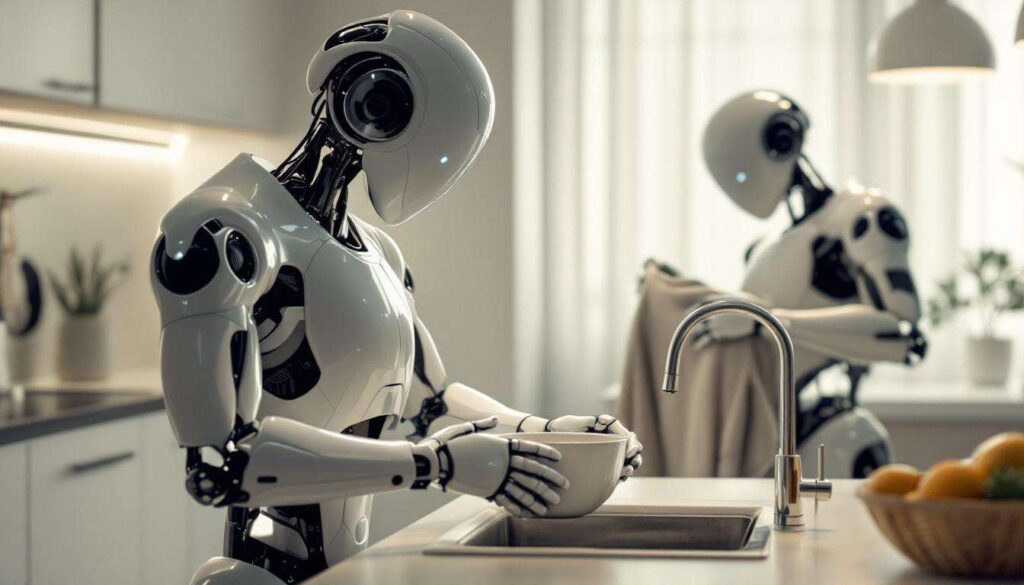
Domestic technology has reached a pivotal moment as humanoid robots equipped with artificial intelligence capabilities step out of science fiction and into practical reality. These machines, designed to tackle everyday household tasks from washing dishes to sorting laundry, represent a fundamental shift in how we approach home management. The latest generation of robots combines sophisticated sensors, machine learning algorithms, and human-like dexterity to perform chores that were previously beyond the reach of automated systems.
AI humanoid robots make their debut at CES 2026
A landmark event for physical AI technology
The Consumer Electronics Show held in Las Vegas showcased an unprecedented array of humanoid robots designed for domestic applications. Spanning over 2.6 million square feet of exhibition space, the event gathered more than 4,100 exhibitors presenting innovations that blur the boundaries between industrial robotics and consumer products. The central theme revolved around what industry experts termed physical AI, marking a departure from software-based artificial intelligence towards machines that interact directly with the physical environment.
Key features distinguishing these robots
Unlike their predecessors, which required constant human supervision, the robots unveiled demonstrate remarkable autonomous capabilities. These machines incorporate:
- advanced vision systems that identify objects and spatial relationships
- tactile sensors enabling delicate manipulation of household items
- natural language processing for voice-activated commands
- machine learning algorithms that adapt to individual household routines
The exhibition floor revealed prototypes capable of navigating cluttered spaces, recognising different fabric types, and adjusting washing parameters accordingly. This level of sophistication represents years of research into making robots practical for everyday use rather than confined to controlled factory environments.
How AI robots are revolutionising household chores
Dishwashing capabilities redefined
The task of washing dishes, traditionally handled by dedicated appliances, has been reimagined through humanoid intervention. These robots can identify dirty plates, scrape off food residue, load dishwashers efficiently, and even hand-wash delicate items that cannot withstand machine cycles. Their articulated hands replicate human finger movements with precision, allowing them to grasp fragile glassware without causing damage.
| Task component | Traditional method | Robot-assisted method |
|---|---|---|
| Loading dishwasher | 5-8 minutes | 3-4 minutes |
| Hand-washing delicates | 10-15 minutes | 6-8 minutes |
| Drying and storage | 5-7 minutes | 4-5 minutes |
Laundry management from start to finish
Laundry represents one of the most time-consuming household responsibilities, involving sorting, washing, drying, folding, and storage. The robots demonstrated at the exhibition handle each stage with minimal human input. They sort clothes by colour and fabric type, adjust washing machine settings based on load composition, transfer items to dryers, and execute complex folding patterns that rival professional laundry services.
One particularly impressive demonstration featured a robot identifying a stained garment, applying appropriate pre-treatment, and selecting an enhanced wash cycle. This level of contextual decision-making showcases how far domestic robotics has progressed beyond simple programmed routines.
These practical applications extend beyond mere convenience, offering solutions for households where physical limitations or time constraints make traditional chore completion challenging. The technology promises to reshape domestic labour fundamentally.
The role of robots in managing the home
Integration with existing smart home ecosystems
Modern humanoid robots function as central hubs within connected homes, communicating with other smart devices to coordinate household operations. They receive data from refrigerators about food inventory, consult calendars to plan meal preparation, and adjust cleaning schedules based on occupancy patterns detected by security systems. This interconnected approach maximises efficiency whilst minimising energy consumption.
Assistance for vulnerable populations
The potential benefits for elderly individuals and those with disabilities cannot be overstated. These robots provide:
- independence for people who struggle with physical tasks
- companionship through conversational AI capabilities
- safety monitoring with fall detection and emergency response
- medication reminders and health tracking support
By handling physically demanding chores, these machines enable individuals to remain in their homes longer, reducing reliance on institutional care facilities. The social implications extend beyond convenience into genuine quality-of-life improvements for millions of people worldwide.
As robots assume more household responsibilities, questions arise about their long-term viability and the specific models leading this transformation.
Showcasing standout models at CES 2026
The CLOiD system and its mobile platform
Among the most discussed exhibits was a mobile robot mounted on an adaptive chassis, capable of navigating stairs and uneven surfaces. This model features articulated arms that can reach into washing machines, handle detergent containers, and transfer clothes between appliances. Its modular design allows for attachment upgrades, potentially extending its functionality to other household tasks as software updates become available.
Compact designs for smaller living spaces
Recognising that not all households possess expansive floor plans, several manufacturers presented compact humanoid robots optimised for flats and smaller homes. These machines feature retractable limbs and vertical storage capabilities, occupying minimal space when not in use. Despite their reduced size, they maintain impressive functionality through clever engineering and efficient component placement.
Projected production volumes and timelines
Industry announcements indicated ambitious manufacturing plans, with one major producer targeting 30,000 units by 2028. This production scale suggests confidence in consumer demand and represents a significant investment in manufacturing infrastructure. The transition from prototype to mass production remains a critical test for the entire sector.
Whilst these technological achievements inspire optimism, practical considerations regarding adoption cannot be ignored.
The challenges of adopting domestic robots
Financial accessibility concerns
Current pricing estimates place these robots well beyond the reach of average households. Early models may cost between £15,000 and £35,000, positioning them as luxury items rather than mass-market appliances. The economic barrier raises questions about:
- equitable access to labour-saving technology
- potential widening of socioeconomic divides
- financing options and subscription models
- long-term cost-benefit analyses for households
Privacy and security considerations
Robots equipped with cameras, microphones, and internet connectivity introduce significant privacy vulnerabilities. Concerns include unauthorised data collection, potential hacking risks, and the surveillance implications of having always-on devices throughout living spaces. Manufacturers must address these issues through robust encryption, transparent data policies, and user-controlled privacy settings.
Impact on employment patterns
The automation of household tasks carries broader economic implications. Professional cleaning services, laundry businesses, and domestic workers may face reduced demand as robots become more capable and affordable. This technological displacement requires thoughtful policy responses, including retraining programmes and social safety nets for affected workers.
Despite these obstacles, the trajectory of household robotics points towards continued development and refinement.
Future prospects for household robots
Anticipated technological improvements
The next generation of domestic robots will likely incorporate enhanced artificial intelligence capable of understanding complex instructions and adapting to household preferences with minimal programming. Advances in battery technology promise extended operation times, whilst improved materials reduce manufacturing costs. Future models may feature:
- more natural movement patterns mimicking human efficiency
- expanded task repertoires including cooking and childcare assistance
- improved energy efficiency reducing operational costs
- modular components allowing customisation and repairs
Regulatory frameworks under development
Governments worldwide are beginning to establish safety standards and certification requirements for domestic robots. These regulations will address mechanical safety, data protection, and liability issues when robots cause damage or injury. Industry collaboration with regulatory bodies ensures that standards promote innovation whilst protecting consumers.
Shifting cultural attitudes towards automation
As robots become more prevalent, societal perceptions will evolve. The stigma associated with outsourcing household labour may diminish as automation becomes normalised. Younger generations, already comfortable with digital assistants and smart home devices, will likely embrace humanoid robots more readily than older demographics. This generational shift will accelerate adoption rates and drive further investment in the sector.
The convergence of affordable pricing, improved capabilities, and changing attitudes suggests that household robots will transition from novelties to necessities within the coming decade. Their integration into daily life represents not merely a technological advancement but a fundamental reimagining of domestic organisation and personal time management.
The emergence of AI-powered humanoid robots capable of managing household chores marks a transformative moment in domestic technology. These machines offer substantial benefits including time savings, assistance for vulnerable populations, and integration with smart home systems. However, significant challenges remain regarding affordability, privacy protection, and employment impacts. As production scales increase and technology matures, robots will likely become commonplace household fixtures, fundamentally altering how we approach daily tasks and manage our living spaces. The path forward requires balancing innovation with ethical considerations, ensuring these powerful tools serve broad societal interests rather than exacerbating existing inequalities.