



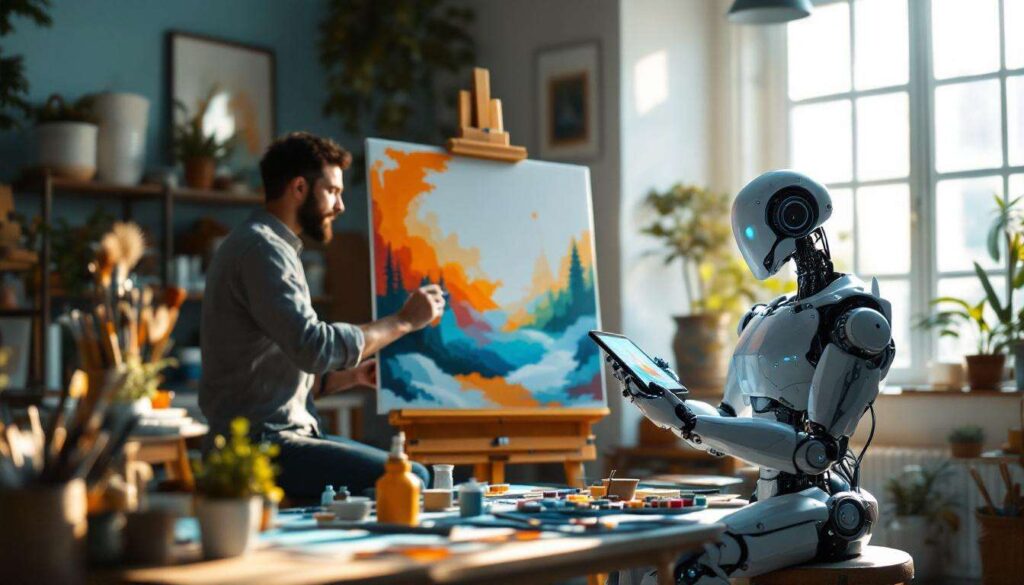
The question of whether machines can truly rival human imagination has sparked intense debate across scientific and artistic communities. As artificial intelligence systems demonstrate increasingly sophisticated outputs in fields traditionally reserved for human ingenuity, researchers are examining the fundamental nature of creative thought itself. Recent studies suggest that whilst AI can generate impressive results, the essence of creativity may remain distinctly human.
The new feats of artificial intelligence in creativity
Breakthrough achievements in generative AI
Artificial intelligence has achieved remarkable milestones in creative domains over recent years. Systems now generate photorealistic images from text descriptions, compose music across multiple genres, and produce written content that often passes as human-authored. These capabilities extend beyond simple pattern replication, demonstrating an ability to combine concepts in novel ways that superficially resemble human creative processes.
The technology has proven particularly effective in several areas:
- Visual arts, where AI creates original paintings and designs
- Musical composition, producing scores across classical and contemporary styles
- Literary works, including poetry and narrative fiction
- Architectural design, generating innovative structural concepts
Commercial applications reshaping industries
The integration of AI into creative industries has accelerated dramatically. Marketing departments now leverage these tools extensively, with approximately 85% of social media marketers utilising generative AI for content creation. This widespread adoption reflects both the efficiency gains and the quality improvements that modern systems deliver. Businesses benefit from rapid prototyping, cost reduction, and the ability to produce vast quantities of content tailored to specific audiences.
| Creative Field | AI Adoption Rate | Primary Use Case |
|---|---|---|
| Marketing | 85% | Social media content |
| Graphic Design | 72% | Concept generation |
| Music Production | 58% | Background scores |
These technological advances naturally raise questions about how we should measure and evaluate machine creativity against human standards.
The impact of creativity tests on AI evaluation
Measuring creative output objectively
Researchers have developed various frameworks to assess creative performance, applying these methodologies to both human and artificial intelligence outputs. Traditional creativity tests examine factors such as originality, fluency, flexibility, and elaboration. When AI systems undergo these evaluations, results reveal intriguing patterns that challenge conventional assumptions about machine capabilities.
Studies published in the Journal of Creative Behavior provide crucial insights into AI performance levels. Research indicates that artificial intelligence consistently operates within a range between amateur and professional human creators. This positioning suggests that whilst AI can exceed novice efforts, it struggles to match the most accomplished human artists and thinkers.
The limitations of standardised assessment
Standard creativity tests face inherent challenges when applied to AI systems. These assessments were designed with human cognitive processes in mind, potentially overlooking unique aspects of machine-generated creativity. Furthermore, the tests often fail to capture emotional resonance, cultural significance, and the intentionality that characterises human creative work. This methodological gap complicates direct comparisons and suggests that entirely new evaluation frameworks may be necessary.
Understanding these measurement challenges leads naturally to examining the fundamental differences between human and artificial creative processes.
Comparison between human and AI creativity
The emotional dimension of human creativity
Human creativity draws upon lived experience, emotional depth, and cultural context in ways that current AI systems cannot replicate. When humans create, they channel personal narratives, psychological states, and social awareness into their work. This emotional energy imbues art with layers of meaning that resonate with audiences on profound levels. A painter’s brushstrokes may reflect grief or joy; a composer’s melody might capture longing or triumph. These qualities emerge from consciousness and subjective experience.
AI’s pattern-based approach
Artificial intelligence operates through fundamentally different mechanisms. Systems analyse vast datasets, identifying patterns and statistical relationships that inform their outputs. This approach enables impressive mimicry and novel combinations, yet it lacks the intentionality and self-awareness that characterise human creativity. AI cannot comprehend the human experiences it appears to represent, nor can it genuinely feel the emotions it seemingly expresses through generated content.
Key distinctions include:
- Humans create from personal experience; AI synthesises from training data
- Human work carries intentional meaning; AI output reflects probabilistic patterns
- Artists develop unique styles through individual growth; AI replicates learned aesthetics
- Human creativity involves risk-taking and vulnerability; AI optimises for learned preferences
These fundamental differences highlight specific boundaries that constrain artificial creativity in meaningful ways.
The current limits of artificial creativity
The absence of genuine understanding
Perhaps the most significant limitation facing AI creativity is the absence of true comprehension. Systems process information without understanding its significance, generating outputs that may appear meaningful whilst lacking genuine insight. This superficiality becomes apparent when AI produces work that is technically proficient yet emotionally hollow or contextually inappropriate. The technology cannot grasp why certain creative choices resonate with human audiences or how cultural nuances shape artistic interpretation.
Dependency on existing patterns
Artificial intelligence remains fundamentally constrained by its training data. Unlike humans who can draw inspiration from entirely novel experiences or imagine scenarios beyond their direct knowledge, AI systems recombine existing elements in new configurations. This derivative nature limits the potential for truly revolutionary creative breakthroughs that challenge established paradigms. Whilst AI can optimise and iterate within known parameters, it struggles to transcend them entirely.
Additional constraints include:
- Inability to establish original artistic vision or philosophy
- Lack of capacity for self-reflection and creative growth
- Absence of moral reasoning in creative decision-making
- Difficulty contextualising work within broader cultural movements
Recognising these limitations has prompted exploration of alternative models where human and artificial intelligence work together rather than compete.
When AI collaborates with humans: the advantages of co-creation
Complementary strengths in partnership
The most promising applications of AI in creative fields involve collaborative frameworks where technology augments human capabilities rather than replacing them. In these partnerships, AI handles time-consuming technical tasks, generates multiple options rapidly, and explores variations that humans might overlook. Meanwhile, human creators provide emotional intelligence, strategic direction, and the critical judgement necessary to select and refine outputs. This division of labour leverages the distinct strengths of both participants.
Practical benefits of human-AI collaboration
Professionals across creative industries report substantial advantages when working alongside AI tools. Designers use systems to generate initial concepts, then apply their expertise to develop the most promising ideas. Musicians employ AI for accompaniment or variation generation whilst maintaining artistic control over composition. Writers utilise technology for research, drafting, and editing support, freeing mental resources for higher-level creative thinking.
| Collaboration Aspect | Human Contribution | AI Contribution |
|---|---|---|
| Ideation | Vision and direction | Rapid variation generation |
| Execution | Emotional nuance | Technical precision |
| Refinement | Critical judgement | Iterative optimisation |
This collaborative model suggests a future where technology enhances rather than replaces human creativity, challenging professionals to adapt their roles whilst preserving the essential human elements that give creative work its deepest meaning.
The evidence suggests that whilst artificial intelligence continues advancing in impressive ways, fundamental aspects of human creativity remain beyond its reach. Machines excel at pattern recognition and rapid generation but lack the emotional depth, lived experience, and genuine understanding that characterise human creative expression. Rather than viewing AI as a competitor, the most productive approach involves embracing collaborative models where technology amplifies human capabilities. As creative professionals adapt to this evolving landscape, the enduring value of human imagination, intentionality, and emotional intelligence becomes increasingly apparent. The future of creativity likely lies not in choosing between human and artificial intelligence, but in discovering how they can work together most effectively.