



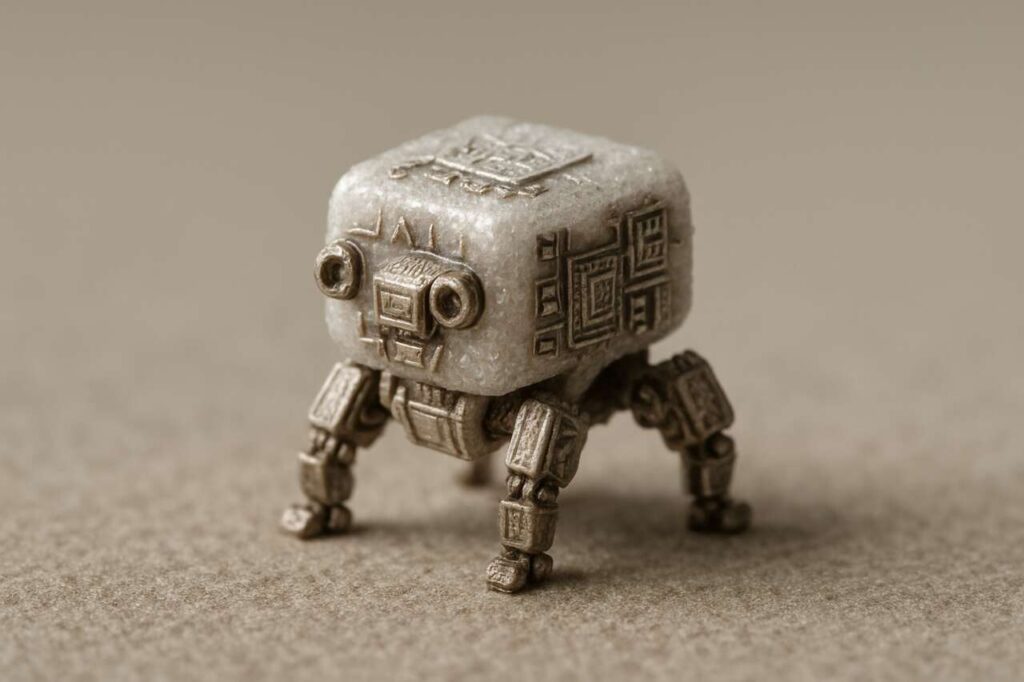
Robotics has long been associated with machines visible to the naked eye, yet recent scientific achievements have shattered this conventional understanding. Researchers have now succeeded in engineering robots so diminutive that they measure smaller than a grain of salt, whilst possessing the remarkable ability to process information, navigate their environment and sustain functionality over extended periods. This development represents a convergence of nanotechnology, computer science and engineering that pushes the boundaries of what autonomous machines can achieve at the microscopic scale.
Microscopic robots: a major technological breakthrough
Unprecedented dimensions and capabilities
These revolutionary machines measure approximately 200 by 300 by 50 micrometres, placing them in a size category comparable to microscopic organisms such as paramecia or certain bacteria. To provide perspective, a standard grain of table salt typically measures around 300 micrometres, making these robots genuinely smaller than this everyday reference point. Despite their diminutive proportions, the devices incorporate sensors, processing units and propulsion mechanisms that enable them to function autonomously.
The robots operate entirely on light energy, eliminating the need for conventional batteries that would prove impossible to miniaturise to such scales. This power source allows them to function continuously whilst maintaining their compact dimensions. Their fully programmable nature means they can be assigned specific tasks and adapt their behaviour based on environmental inputs received through their integrated sensors.
Overcoming physical constraints at microscopic scales
Operating at such minute dimensions presents challenges that differ fundamentally from those encountered in conventional robotics. At the microscopic scale, physical forces behave differently:
- Viscosity becomes a dominant force, making movement through fluids comparable to a human attempting to swim through honey
- Surface tension effects become proportionally more significant than gravitational forces
- Inertia plays a negligible role, requiring entirely different propulsion strategies
- Thermal fluctuations can impact movement and positioning
The research teams addressed these constraints through innovative design approaches that harness rather than fight against these microscopic physical phenomena. Understanding how these machines overcome such fundamental challenges provides insight into their creation process.
The process of creating these miniature robots
Manufacturing techniques at microscopic scales
Producing robots at such diminutive dimensions requires fabrication methods borrowed from semiconductor manufacturing. The teams employed techniques including photolithography, thin-film deposition and etching processes typically used in microchip production. These methods allow for precise structuring of materials at the micrometre scale, creating the mechanical components, sensors and circuitry necessary for robot functionality.
One of the most remarkable aspects of this achievement is the estimated production cost of approximately one cent per robot. This economic feasibility stems from the ability to manufacture thousands of units simultaneously on a single substrate, similar to how computer chips are mass-produced. The low cost per unit opens possibilities for applications requiring large numbers of robots working collaboratively.
Integration of sensing and processing capabilities
Embedding computational capabilities into such confined spaces represents a significant engineering accomplishment. The robots incorporate:
- Miniaturised sensors capable of detecting chemical gradients, light intensity and physical obstacles
- Processing algorithms that interpret sensory data and determine appropriate responses
- Control systems that translate decisions into physical movements
- Communication mechanisms enabling coordination between multiple robots
| Component | Function | Size constraint |
|---|---|---|
| Sensors | Environmental detection | Under 50 micrometres |
| Processor | Decision-making | Integrated into structure |
| Actuators | Movement generation | Microscale propulsion |
| Power system | Light energy conversion | Surface-integrated |
The ability to think, in this context, refers to autonomous decision-making based on programmed algorithms and real-time sensory input. This capability distinguishes these machines from simpler microdevices that merely respond to external control signals. With these sophisticated systems in place, the question becomes how effectively they can navigate and operate independently.
The challenges of navigation and autonomy
Swimming through viscous environments
Traditional propulsion methods prove ineffective at microscopic scales. The robots cannot rely on propellers or jets as larger vessels do, because viscosity dominates over inertia in their operational environment. Instead, they employ propulsion strategies inspired by microorganisms, such as oscillating appendages or surface-tension manipulation. These techniques allow them to generate thrust despite the honey-like resistance of fluids at their scale.
Navigation presents additional complexity beyond simple movement. The robots must:
- Determine their position relative to targets or landmarks
- Plot efficient routes through three-dimensional spaces
- Avoid obstacles that may be orders of magnitude larger than themselves
- Maintain orientation in environments where gravitational cues are negligible
Sustained operation over extended periods
The robots demonstrate operational lifespans extending to several months, a remarkable achievement given their size and complexity. This longevity results from several design considerations: the absence of mechanical wear in carefully designed components, the reliability of light-based power systems and the robustness of their integrated circuits against environmental stresses.
Autonomy also encompasses the ability to make independent decisions without constant external guidance. The embedded algorithms enable the robots to respond appropriately to unexpected situations, adjust their behaviour based on mission progress and coordinate with other units when operating in swarms. These autonomous capabilities become particularly valuable when considering practical deployment scenarios.
Potential applications in the medical field
Targeted interventions within the human body
The medical applications of these microscopic robots present perhaps the most compelling prospects. Their size allows them to navigate through blood vessels, lymphatic channels and other bodily conduits that remain inaccessible to conventional surgical instruments. Potential interventions include:
- Delivering medications directly to diseased cells whilst sparing healthy tissue
- Clearing arterial blockages by physically removing plaque deposits
- Identifying and marking cancerous cells for targeted treatment
- Performing microsurgical repairs on damaged tissues
- Monitoring physiological conditions from within specific organs
Diagnostic and therapeutic possibilities
Beyond direct intervention, these robots could revolutionise diagnostic procedures. Equipped with appropriate sensors, they might detect biochemical markers of disease at very early stages, potentially identifying conditions before symptoms manifest. Their ability to transmit data could provide physicians with unprecedented insights into internal bodily processes.
| Application area | Potential benefit | Current status |
|---|---|---|
| Drug delivery | Precision targeting | Research phase |
| Cancer treatment | Cell-specific intervention | Experimental |
| Vascular repair | Non-invasive surgery | Conceptual |
| Diagnostics | Early detection | Development |
The medical possibilities alone justify continued development, yet the technology’s potential extends well beyond healthcare applications.
Future prospects for microscopic-sized robots
Industrial and manufacturing applications
Beyond medicine, these robots could transform precision manufacturing at microscopic scales. They might assemble complex nanostructures, perform quality control inspections on microelectronics or repair defects in manufactured components too small for human intervention. Their low production cost makes them economically viable for industrial deployment where they might be considered consumable tools rather than reusable equipment.
Environmental monitoring and remediation
Environmental applications represent another promising frontier. Swarms of these robots could monitor water quality by detecting pollutants at the molecular level, track the spread of contaminants through ecosystems or even participate in remediation efforts by collecting or neutralising harmful substances. Their ability to operate autonomously for months makes them suitable for long-term environmental surveillance missions.
Research and development directions
Current capabilities, whilst impressive, represent only initial achievements. Future development efforts will likely focus on:
- Enhancing computational power within the same dimensional constraints
- Improving energy efficiency to extend operational lifespans further
- Developing more sophisticated sensors for diverse detection requirements
- Creating swarm coordination algorithms for large-scale collaborative tasks
- Establishing reliable communication protocols between robots and external controllers
The combination of affordability, capability and versatility positions these microscopic robots as a foundational technology that may influence numerous fields. As research progresses, the gap between experimental demonstrations and practical deployments will narrow, bringing these remarkable machines closer to everyday applications.
The development of thinking robots smaller than a grain of salt marks a watershed moment in robotics and nanotechnology. These devices successfully integrate sensing, processing and propulsion capabilities within dimensions previously considered impossibly small for autonomous machines. Their ability to operate independently for months whilst navigating viscous microscopic environments demonstrates solutions to fundamental physical challenges. Medical applications offer particularly compelling prospects, from targeted drug delivery to minimally invasive diagnostics. The remarkably low production cost of approximately one cent per unit enables large-scale deployment across medicine, manufacturing and environmental monitoring. As research teams continue refining these technologies, the microscopic robots will likely transition from laboratory curiosities to practical tools addressing real-world challenges across multiple sectors.