



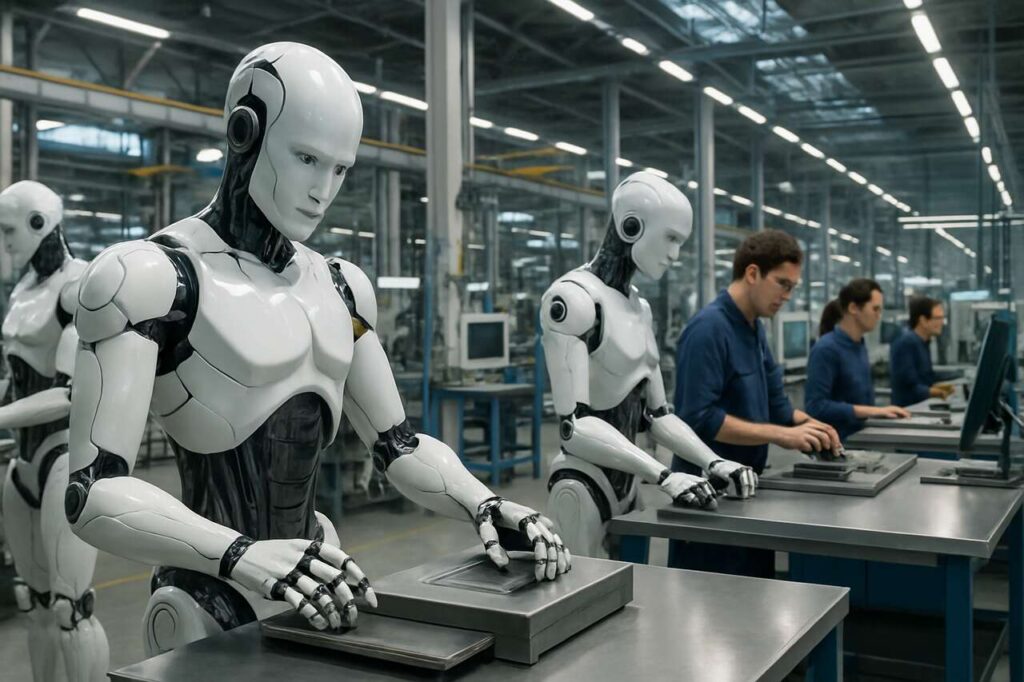
Manufacturing floors across the globe are witnessing a transformation that would have seemed like science fiction just a decade ago. Humanoid robots, once confined to research laboratories and technology showcases, are now quietly making their way into production facilities. These bipedal machines, designed to mimic human form and movement, are beginning to perform tasks alongside their human counterparts with increasing sophistication and reliability.
Introduction of humanoids in the industry
The deployment of humanoid robots in manufacturing environments represents a significant shift in industrial automation strategy. Unlike traditional robotic arms fixed to assembly lines, these machines possess the ability to navigate spaces designed for human workers, climb stairs, and manipulate tools originally created for human hands.
Early adopters and pilot programmes
Several major manufacturers have begun integrating humanoid robots into their operations through carefully monitored pilot schemes. Automotive plants, electronics assembly facilities, and logistics warehouses have emerged as the primary testing grounds for this technology. These environments offer controlled conditions where humanoids can demonstrate their capabilities whilst minimising operational risks.
- Automotive assembly lines utilising humanoids for quality inspection tasks
- Electronics manufacturers deploying robots for component handling
- Warehouse operations incorporating humanoids for inventory management
- Aerospace facilities testing robots for precision assembly work
Practical applications in current use
The practical deployment of humanoid robots focuses primarily on tasks that are repetitive, physically demanding, or potentially hazardous for human workers. These machines excel at maintaining consistent performance levels over extended periods, operating in environments with extreme temperatures, and accessing confined spaces where human ergonomics pose challenges.
| Industry sector | Primary application | Deployment stage |
|---|---|---|
| Automotive | Parts inspection | Active pilot |
| Electronics | Component assembly | Limited production |
| Logistics | Material handling | Testing phase |
| Pharmaceuticals | Clean room operations | Early adoption |
Understanding how these machines have reached their current level of capability requires examining the technological advances that have made their industrial deployment feasible.
The technological evolution of robots
The journey from rudimentary mechanical systems to sophisticated humanoid platforms has been marked by breakthroughs in multiple technological domains. Modern humanoids integrate advances in artificial intelligence, sensor technology, materials science, and power management systems.
Advances in artificial intelligence and machine learning
Machine learning algorithms have transformed how humanoid robots perceive and interact with their surroundings. Computer vision systems enable these machines to identify objects, assess spatial relationships, and adapt to variations in their working environment. Natural language processing capabilities allow for intuitive human-robot interaction, whilst reinforcement learning techniques enable robots to improve their performance through experience.
Mechanical and sensor improvements
The physical capabilities of humanoid robots have expanded dramatically through innovations in actuator design, balance control, and tactile sensing. Advanced servo motors provide precise movement control, whilst sophisticated gyroscopic systems maintain stability during complex manoeuvres. Force-feedback sensors allow robots to handle delicate components without causing damage, replicating the sensitivity of human touch.
- High-torque electric motors enabling human-like movement ranges
- Distributed sensor networks providing real-time environmental feedback
- Advanced battery systems extending operational duration
- Lightweight composite materials reducing energy consumption
These technological improvements have not only enhanced robot capabilities but have also influenced the economic calculations surrounding their adoption.
The economic benefits of humanoids
The financial justification for humanoid deployment extends beyond simple labour cost comparisons. Manufacturers evaluate these investments through multiple economic lenses, considering both immediate operational impacts and long-term strategic advantages.
Cost reduction and productivity gains
Humanoid robots operate continuously without fatigue, breaks, or shift changes, providing consistent productivity levels throughout their operational periods. This reliability translates into predictable output rates and reduced variability in product quality. Maintenance costs, whilst significant, remain lower than the cumulative expenses associated with human workforce management, including recruitment, training, benefits, and turnover.
Operational flexibility and scalability
Manufacturing flexibility represents a crucial advantage of humanoid systems. These robots can be reprogrammed for different tasks, allowing facilities to adapt production lines rapidly in response to market demands. Unlike fixed automation systems that require substantial reconfiguration, humanoids can transition between roles with minimal downtime.
| Economic factor | Traditional automation | Humanoid robots |
|---|---|---|
| Initial investment | High | Moderate to high |
| Reconfiguration cost | Very high | Low |
| Operating hours | 24/7 | 20-22 hours daily |
| Task flexibility | Limited | High |
Whilst the economic arguments for humanoid adoption appear compelling, their introduction raises important questions about workforce dynamics and employment patterns.
Impacts on the job market
The integration of humanoid robots into manufacturing inevitably affects employment landscapes, creating both challenges and opportunities for workers and industries alike.
Displacement concerns and workforce adaptation
Job displacement remains the most immediate concern associated with humanoid deployment. Roles involving repetitive manual tasks, hazardous operations, and physically demanding work face the highest risk of automation. However, historical patterns suggest that technological advancement typically reshapes rather than eliminates employment opportunities.
Emerging roles and skill requirements
The humanoid revolution generates demand for new categories of skilled workers. Robot maintenance technicians, AI training specialists, and human-robot collaboration coordinators represent emerging professions within manufacturing environments. These positions require different skill sets, emphasising technical knowledge, problem-solving abilities, and adaptability.
- Robot programming and configuration specialists
- Maintenance engineers with mechatronics expertise
- Quality assurance professionals monitoring robot performance
- Human-robot interaction designers
- AI training data specialists
As employment patterns shift, society must also grapple with broader questions about the appropriate governance and ethical frameworks for humanoid deployment.
The ethical and regulatory challenges
The proliferation of humanoid robots in industrial settings raises complex ethical questions and regulatory considerations that extend beyond purely technical or economic concerns.
Safety standards and liability frameworks
Safety protocols for human-robot collaboration require careful development and enforcement. Establishing clear liability frameworks for incidents involving humanoid robots presents challenges for legal systems designed around human agency. Questions of responsibility when robots malfunction or cause harm demand new regulatory approaches.
Social and philosophical considerations
The increasing presence of human-like machines in workplaces prompts reflection on the nature of work itself and humanity’s relationship with technology. Issues of worker dignity, the psychological impact of robot colleagues, and the societal implications of widespread automation require thoughtful consideration alongside technical development.
These ethical and regulatory questions will shape how humanoid technology evolves and integrates into broader industrial ecosystems.
The future of automation in factories
The trajectory of humanoid robotics in manufacturing suggests continued expansion and sophistication, with several trends likely to define the coming phase of industrial automation.
Predicted developments and innovations
Technological refinement will enhance humanoid capabilities, improving dexterity, decision-making speed, and energy efficiency. Advanced AI systems will enable more complex problem-solving and greater autonomy, whilst improved human-robot interfaces will facilitate seamless collaboration between biological and mechanical workers.
Integration with broader Industry 4.0 initiatives
Humanoid robots will increasingly function as components within interconnected smart factory ecosystems. Integration with Internet of Things networks, cloud computing platforms, and advanced analytics systems will enable coordinated operations across entire production facilities, optimising efficiency and responsiveness.
The quiet rise of factory humanoids represents more than a technological novelty. These machines embody a fundamental shift in manufacturing philosophy, moving towards flexible, adaptive production systems that combine human creativity with mechanical precision. Whilst challenges remain in workforce adaptation, regulatory development, and ethical governance, the trajectory appears clear. Humanoid robots are transitioning from experimental curiosities to practical tools, reshaping industrial landscapes in ways both subtle and profound. The factories of tomorrow will likely feature humans and humanoids working in concert, each contributing their unique strengths to the manufacturing process.