



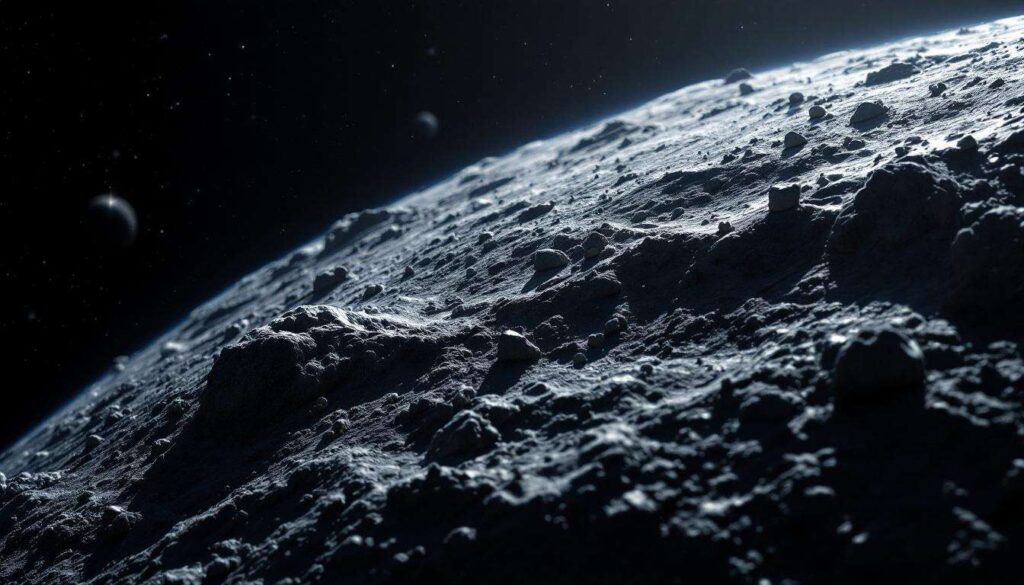
Scientists have long wondered whether the building blocks of life on Earth originated from our own planet or arrived from the cosmos. Recent analyses of samples collected from asteroid Bennu have provided compelling evidence that these ancient space rocks harbour all the essential chemical ingredients necessary for life as we understand it. This remarkable discovery offers unprecedented insights into the conditions that may have seeded biological processes on our planet billions of years ago.
Discovery of asteroid Bennu: a cosmic treasure
Identification and characteristics of the asteroid
Asteroid Bennu, officially designated 101955 Bennu, was discovered in September 1999 by the LINEAR Project telescope in New Mexico. This near-Earth asteroid belongs to the Apollo group and measures approximately 490 metres in diameter. Its relatively small size belies its immense scientific value, as Bennu represents a pristine remnant from the early solar system.
The asteroid completes an orbit around the Sun every 436.6 days and occasionally crosses Earth’s orbital path, making it both accessible for study and a potential impact hazard in the distant future. Its dark, carbon-rich surface reflects only about four per cent of the sunlight that strikes it, giving Bennu its characteristic coal-black appearance.
Why Bennu attracted scientific attention
Researchers identified Bennu as an ideal target for detailed study for several compelling reasons:
- Its proximity to Earth makes it accessible for spacecraft missions
- The asteroid’s composition suggests it has remained largely unchanged since the solar system’s formation
- Its relatively slow rotation allows for safer spacecraft operations
- Spectroscopic observations indicated the presence of hydrated minerals and organic compounds
These factors combined to make Bennu a prime candidate for sample collection, promising to unlock secrets about the chemical environment of the early solar system. The asteroid’s primitive nature suggested it could contain materials that predate Earth itself, offering a window into conditions that existed more than 4.5 billion years ago.
Chemical composition of Bennu: a mirror of primordial Earth
Carbonaceous materials and their significance
Analysis of Bennu’s composition reveals it belongs to a rare class of carbonaceous asteroids, which constitute less than ten per cent of known asteroids. These objects contain high concentrations of carbon-based compounds and water-bearing minerals, making them remarkably similar to the materials thought to have been present during Earth’s formation.
| Component | Percentage in Bennu samples | Significance |
|---|---|---|
| Carbon compounds | 4-5% | Organic molecule precursors |
| Water-bearing minerals | Significant presence | Evidence of aqueous alteration |
| Silicate minerals | Majority component | Rocky foundation material |
Evidence of water and mineral alteration
One of the most striking discoveries within Bennu samples is the presence of phyllosilicate minerals, which form only in the presence of liquid water. This finding confirms that Bennu’s parent body experienced significant aqueous alteration early in its history, creating chemical environments where complex organic molecules could form and interact.
The detection of hydrated minerals suggests that water was once abundant within the asteroid’s parent body, creating conditions conducive to the chemical reactions necessary for life’s precursors. This aqueous environment would have facilitated the synthesis of increasingly complex organic molecules from simpler starting materials.
Key ingredients for life contained in Bennu
Amino acids and organic molecules
Laboratory analysis of returned samples has identified numerous amino acids, the fundamental building blocks of proteins essential to all known life. These organic compounds include both those commonly found in terrestrial biology and others that are rare or absent on Earth, demonstrating their extraterrestrial origin.
The diversity of amino acids discovered includes:
- Glycine, the simplest amino acid
- Alanine and other protein-forming amino acids
- Non-biological amino acids not found in Earth’s biosphere
- Complex organic polymers and macromolecules
Nucleobases and genetic material precursors
Perhaps most remarkably, scientists have identified nucleobases within Bennu samples, including compounds such as adenine and guanine that form essential components of DNA and RNA. These discoveries provide tangible evidence that the chemical ingredients for genetic information storage existed in the early solar system, long before life emerged on Earth.
The presence of these molecules suggests that asteroids like Bennu could have delivered the raw materials necessary for the development of self-replicating systems to the early Earth through impacts. This finding strengthens theories proposing that life’s origins may have been assisted by cosmic delivery of prebiotic compounds.
Encounters with Bennu: missions and space discoveries
OSIRIS-REx mission overview
NASA’s Origins, Spectral Interpretation, Resource Identification, Security-Regolith Explorer (OSIRIS-REx) spacecraft launched in September 2016 with the ambitious goal of collecting samples from Bennu and returning them to Earth. After a two-year journey, the spacecraft arrived at Bennu in December 2018 and spent over two years conducting detailed surveys and mapping operations.
The mission achieved several historic milestones, including becoming the smallest object ever orbited by a spacecraft and executing the most precise asteroid orbit insertion ever accomplished. These technical achievements enabled scientists to study Bennu’s surface composition, structure and dynamics with unprecedented detail.
Sample collection and return to Earth
In October 2020, OSIRIS-REx performed a daring Touch-And-Go (TAG) manoeuvre, briefly contacting Bennu’s surface to collect samples. The spacecraft gathered approximately 250 grammes of material, far exceeding the mission’s minimum requirement. After departing Bennu in May 2021, the spacecraft began its return journey, successfully delivering the sample capsule to Earth in September 2023.
The pristine samples now undergo intensive analysis in laboratories worldwide, revealing information about asteroid composition, solar system formation and the potential origins of life’s building blocks. These materials represent the largest amount of asteroid material returned to Earth since the Apollo missions brought back lunar samples.
Bennu and the origin of life: scientific hypotheses
Panspermia theory and cosmic seeding
The discovery of life’s chemical precursors in Bennu lends credence to the panspermia hypothesis, which proposes that life’s ingredients or even primitive life forms travelled through space before taking root on Earth. According to this theory, asteroids and comets acted as cosmic delivery vehicles, transporting organic compounds across the solar system during the period of heavy bombardment that characterised Earth’s early history.
This process could have enriched Earth’s primordial oceans with the complex organic molecules necessary for abiogenesis, the natural process by which life arises from non-living matter. The sheer abundance of organic material found in Bennu suggests that such deliveries could have been substantial and frequent.
Implications for life beyond Earth
If asteroids like Bennu contain life’s building blocks, the implications extend far beyond Earth. These findings suggest that the chemical prerequisites for life may be distributed throughout the solar system and potentially throughout the galaxy. This raises the possibility that life could emerge wherever suitable conditions exist, making the universe potentially teeming with biological activity.
The discovery strengthens the scientific case for searching for life on Mars, the icy moons of Jupiter and Saturn, and exoplanets orbiting distant stars. If the ingredients for life are common in space, then the emergence of life itself may be more probable than previously thought.
Future of research: what Bennu could still reveal
Ongoing analysis and new discoveries
Scientists have only begun to scratch the surface of what Bennu’s samples can teach us. Advanced analytical techniques continue to reveal new organic compounds, mineral structures and isotopic signatures that provide clues about conditions in the early solar system. Researchers estimate that detailed study of these samples will continue for decades, with each analysis potentially yielding groundbreaking discoveries.
Future investigations will focus on:
- Determining the exact formation age of organic compounds
- Identifying additional complex molecules and their formation pathways
- Understanding the role of radiation and thermal processes in organic chemistry
- Comparing Bennu materials with samples from other asteroids and comets
Implications for future asteroid missions
The success of OSIRIS-REx has inspired plans for additional asteroid sample return missions. Japan’s Hayabusa2 mission has already returned samples from asteroid Ryugu, providing comparative data. Future missions may target different types of asteroids to build a comprehensive understanding of the diversity of materials present in the asteroid belt.
These missions will help scientists determine whether Bennu’s composition is typical or exceptional, refining our understanding of how organic materials are distributed throughout the solar system. The knowledge gained will also inform strategies for planetary defence and potential asteroid mining operations.
The remarkable findings from asteroid Bennu have fundamentally transformed our understanding of how life’s chemical building blocks may have reached Earth. The presence of amino acids, nucleobases and complex organic molecules in these ancient samples demonstrates that the ingredients for life existed in the early solar system and were likely delivered to our planet through asteroid impacts. As research continues, Bennu’s samples promise to reveal even more about the cosmic origins of life and the potential for biological processes throughout the universe. These discoveries not only illuminate our own origins but also guide the search for life beyond our world, suggesting that the chemical foundations for biology may be far more widespread than once imagined.